The most publishable number nobody tracks
Bitcoin has almost no native bitcoin-denominated lending market, so its own term structure is short and sparse. Meanwhile the dollar curve against bitcoin collateral is deep and liquid in the double digits. Bitcoin earns a little, in bitcoin; dollars cost a lot, against bitcoin. The difference is the subject of this page.
It is a subtraction across a denomination boundary, and the chart says so in words rather than leaving it to be inferred. The two levels are in different units. The difference is a legitimate and interesting thing to compute; it is not itself a rate, and it is never annotated as one.
−8.27 pp
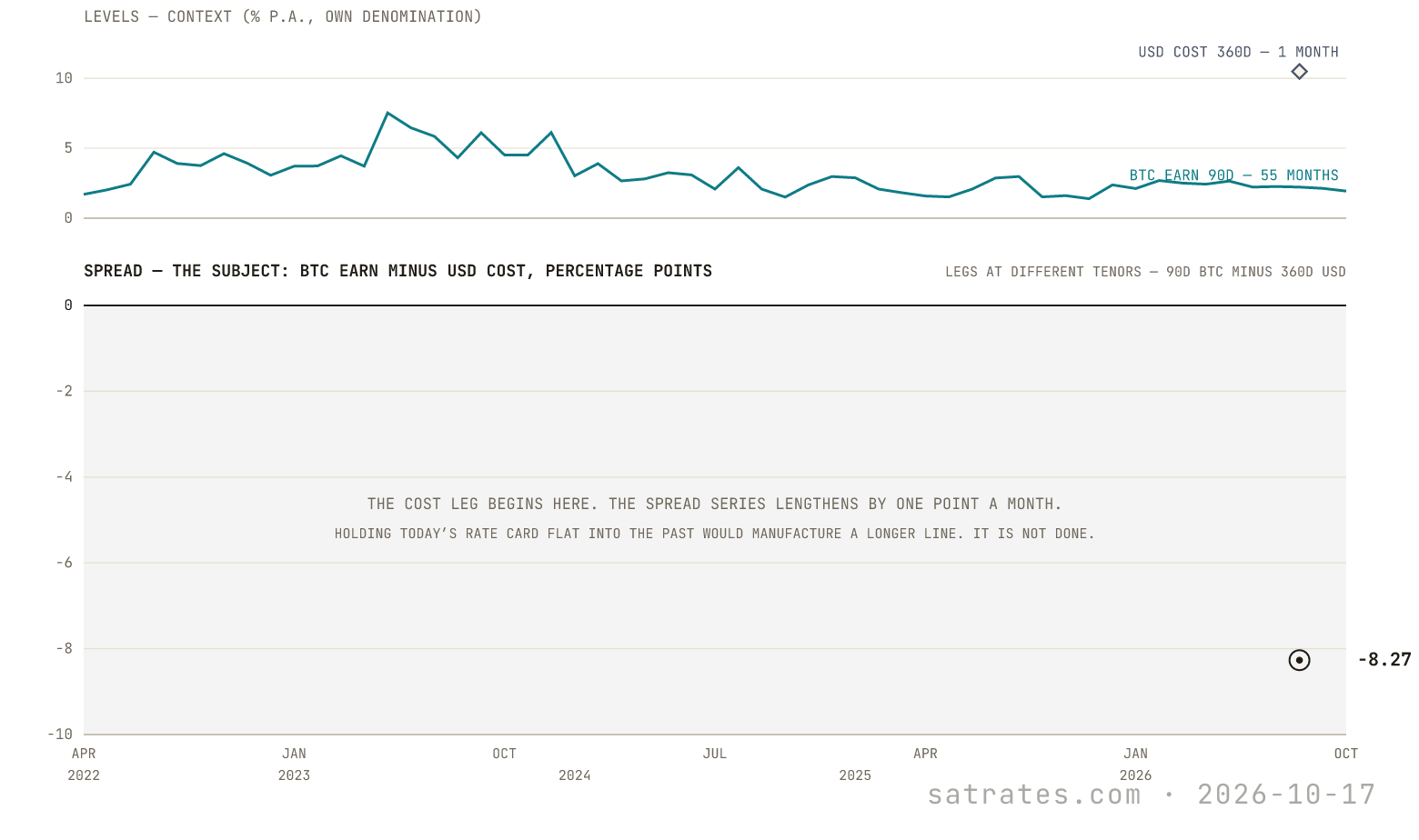
Bitcoin earned 2.22% in bitcoin over a 90D lease while dollars cost 10.49% against bitcoin collateral over 360D, in AUG 2026. The two legs are at different tenors — see below.
LEVELS AND SPREAD
Levels are context; the difference is the subject. Zero sits at the top of the lower panel and the curve hangs below it.
WATERMARKED EXPORT — PNG 2× · SVG · CARRIES THE DATA DATE 2026-10-17, NOT THE EXPORT DATE
The two legs are not at the same tenor
THE TWO LEGS ARE AT DIFFERENT TENORS AND THE LABEL SAYS SO. The BTC-earn leg is the 90-day Magma lease; the nearest published USD cost is a 360-day rate card, because no verified desk quotes a product near three months. The difference therefore carries the dollar term premium between those tenors and is NOT a matched-tenor spread. It is published because a market where the two sides do not quote the same term is itself the finding; it is labelled at both tenors so it cannot be read as one number at one tenor.
This is stated rather than corrected because it cannot be corrected from published data. Stripping the dollar term premium out would require a USD-against-bitcoin rate at the earn leg's tenor, and no verified desk quotes one — they compete on size band and loan-to-value, not on term. SALT publishes a genuine loan-to-value × term grid and is the highest-value desk to verify next; when it lands, the spread gains a matched-tenor leg and this section goes away.
Why the spread is shorter than the levels
The bitcoin-earn leg has real history: 55 monthly medians of cleared Lightning channel leases from 2022.04 to 2026.10, taken at the lease term nearest three months. The dollar-cost leg has no history, because this site did not exist to record it. Lending desks publish a rate card, not a series; a rate card carries no vintage and is overwritten the day it changes.
So the spread begins the day this site started recording rate cards, and it lengthens by one point a month from here. Holding today's rate card flat into the past to manufacture a longer line would be a fabrication, and it would be an invisible one — which is exactly why it is not done. There is one point on the spread series today.
Reading the levels
The bitcoin-earn line has spent 55 months in a band roughly one to six percent, with the most recent reading at 1.93%. It is drawn in teal because it is denominated in bitcoin. The dollar-cost line is drawn in slate because it is denominated in dollars, and the two colours are never reused across the boundary anywhere on this site.
A reader who takes one thing from this page should take this: the gap is not an arbitrage. You cannot earn the bitcoin rate and pay the dollar rate on the same capital, because the two sit in different units at different counterparties with different custody. The gap is the price of that difference, and it is large.